Part 1: The Strange Wonder of Christmas Series
The BBC TV series Ludwig is in my “continue watching” feed. Currently Lorna and I are in Season 2 and we recently watched Episode 3. There’s a scene where John “Ludwig” Taylor (played by David Mitchell) goes to review CCTV footage with the police. As the video streams, he almost loses his mind when he realizes the wall of monitors is completely out of geographical order. The CCTV cameras aren’t in sync with the map on the wall. Please take a moment to watch this humorous clip.
When I saw Taylor going bonkers, I realized we do the same sort of thing to the Christmas story. We want the footage to stream coherently; to curate a continuous event on the screen so the story makes sense.
Without realizing it, most of us carry a mental composite of the nativity; an edited stream where Matthew and Luke’s feeds are spliced together into one seamless scene. In our heads, we imagine the shepherds and the wise men arrive on the same night. The star hangs motionless over a tidy wooden stable. The angels, the census, the frantic midnight flight to Egypt, and the quiet song in the cattle shed all happen on a single, harmonious evening.
It’s a comforting picture. It gives us a warm, familiar loop to play every Christmas season. But in stitching the feeds together so that everything makes chronological sense, we sand down the rough edges. We smooth out two completely different artistic voices. In time the text stops surprising us.
Matthew’s stream runs a wide-angle lens from a high vantage point. He tracks royal paranoia, heavy genealogies, dark prophecies, and a desperate midnight border crossing into exile. Luke, on the other hand, operates a handheld macro lens. He captures a close up of a provincial census, an unexpected outbreak of songs in the street, and a feeding trough in the dark. When we attempt to create a hybrid story on a single screen, we lose the distinct texture of what each writer is trying to show us.
What if, for a time, we turn off the curated composite?
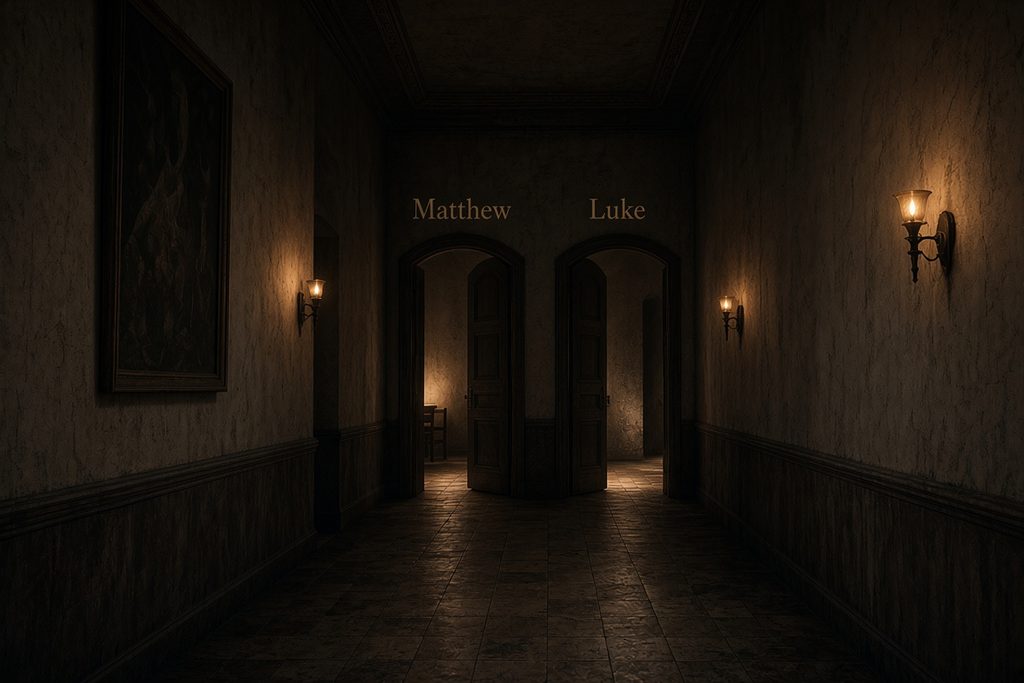
Imagine if you will, standing in a long, quiet, dimly lit hallway, looking at two darkened doorways. They aren’t pitch black, but they stand open – unlit by the glaring floodlights of modern Christmas pageants and carols. Instead, a minimal, amber light spills out from beyond each frame, inviting us to step closer.
One doorway leads into Matthew’s heavy world of history, risk, and royal shadows. The other leads into Luke’s intimate, song-filled world of ordinary life on the ground and sudden, blinding light.
Over the next five weeks, we aren’t going to try and force camera angles to match. We aren’t going to rush in with patches to fill the blanks the authors deliberately left open. We’re just going to step through those doors, one at a time, and let the text speak in its own voice. My hope is that by the time December arrives, the strange wonder of it all might start to glow again.