
Reclaiming the Armour of God as Communal Clothing
Fit For Battle
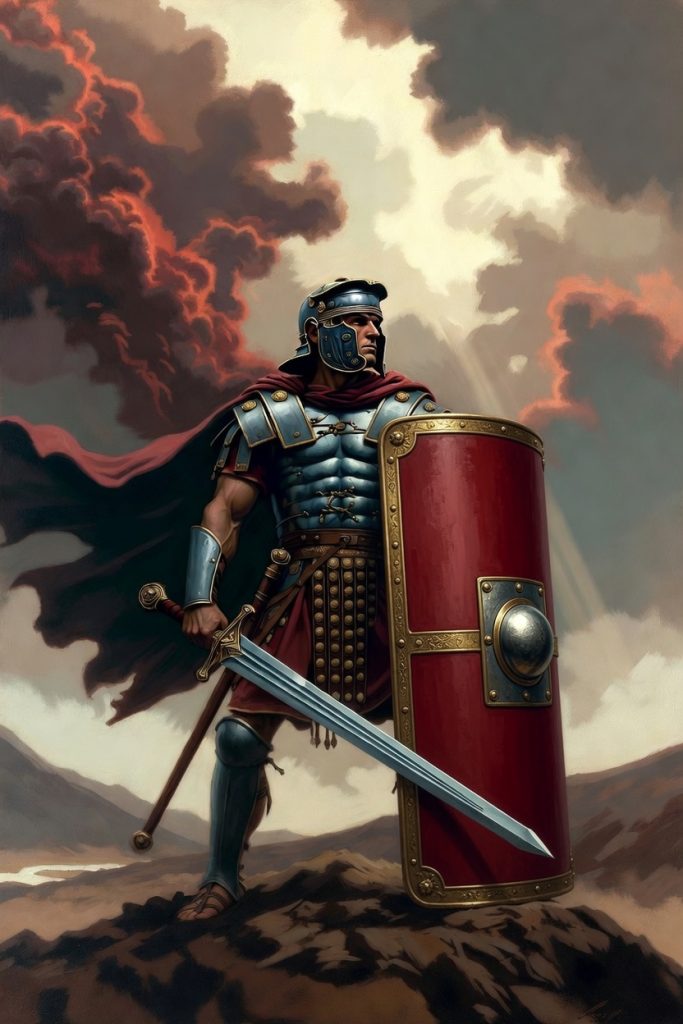
If you have some background in Western church culture, you’ve probably seen a similar image. A solitary, chiseled Roman soldier standing alone on a dramatic hilltop. He’s fully suited in gleaming iron, glaring intensely up into a cloudy sky, gripping a massive broadsword, ready to do battle with evil entities floating in the air – invisible. It’s a powerful image that resonates with our hyper-individualistic culture, shaping exactly how we visualize the armour of God.
Framed in that way, we can see spiritual warfare as a private, heroic endeavor – the “Lone Soldier” story. So, by the time we arrive at Paul’s famous armour of God passage in Ephesians 6, many of us already have expectations.
- Spiritual warfare.
- Battle Imagery.
- Invisible enemies.
- Defensive strategies.
But when we take this Lone Soldier-style imagination and hold it up against the actual text of Ephesians 6:11–18, the picture shatters.
Like me, you may be familiar with how this passage became the defining text for understanding spiritual conflict. Books, sermons, conferences and ministries have been built around how to engage the unseen realm. Yet, when I read Ephesians; the context of what’s written before and after this passage, I have a different question:
What if Paul really isn’t teaching believers how to fight?
What if he’s teaching Christian communities how to remain faithful and endure?
Reading the Whole Letter
One of the challenges with familiar passages is that we often read them in a kind of detached way. Before Paul ever mentions armour, he spends five chapters describing a new humanity formed in Christ. He talks about: love, reconciliation, unity, peace, forgiveness, truthfulness, mutual submission, and shared life together.
Notice how he describes the church:
- A body.
- A household.
- A temple.
- A community.
Throughout his letter, Paul’s concern isn’t about individual spiritual survival but the formation of a people who are a physical expression of the life of Christ together. Then he arrives at chapter six and says:
“Finally…”
The armour of God isn’t a new subject. It sums up everything that came before. When Paul wrote these words, it wasn’t an ancient PDF (Personal Development File) for individual believers. He writes a letter to a very fragile, multi-ethnic network of house churches in Ephesus. Both Jews and Gentiles trying to navigate the messy, high-friction reality of living in a shared community.
Furthermore, every single “you” in Paul’s famous command to “put on the full armour of God” is plural. In the original language, he’s saying, “Y’all need to get dressed.” Paul isn’t dressing a solitary Russell Crowe -type soldier for an aggressive battlefield. He’s clothing a local Christian community in a shared wardrobe designed for collective endurance.
The Prosecutor in the Room
To understand the nature of this battle Paul speaks of, we need to clear away centuries of medieval folklore and recover the historical thinking Paul was actually drawing from.
Modern spiritual warfare frameworks carry an elaborate, speculative demonology that exploded during the Second Temple period. That’s about 600 years – following the Babylonian captivity and the construction of the second temple in Jerusalem through to its destruction by Rome in 70 AD. Then later European history adds more layers to this framework. But Paul’s roots drill deeper into an older, Hebrew Bible interpretive lens of ha-satan.
The language Paul chooses is worth noticing. He urges believers to stand against the schemes of the devil. The Greek word translated “devil” is diabolos. Literally, it means slanderer or accuser. The word stirs up the image of someone who divides through accusation, falsehood, and distortion. Seem familiar?
I spoke about this with more depth in our second article. In the Old Testament, ha-satan isn’t a red monster ruling a fiery underworld, nor is he a cosmic rebel leading an army of invisible warriors to jump-scare you in the dark. Instead, the word is a title:
“The Adversary” or more accurately, “The Accuser.”
The Accuser functions like a ruthless prosecuting attorney in a cosmic courtroom of Law & Order… dun dun! His primary weapon isn’t spectacular supernatural power. Rather, his weapon is prosecutorial accusation, slander, and sowing seeds of relational division. He wins by doing things like pointing fingers, digging up dirt, whispering suspicion, spreading flawed facts and breaking relational commitments.
When Paul warns the Ephesians about the “schemes” (methodeia) of the devil, he’s talking about a legalistic “method” of division. In Ephesus, those schemes look like insidious whispers convincing Jewish Christians that their Gentile neighbors are unclean outsiders who can’t be trusted. Or, telling the Gentiles that the Jews are rigid legalists to be avoided. The “schemes” are the internal scripts of:
- self-righteousness,
- keeping score,
- resentment,
- The subtle suspicion that quietly distorts and dissolves the human community.
The emphasis isn’t an overwhelming force – it’s strategy. The danger isn’t just an attack – it’s the shaping influence of lies. Therefore, building a healthy, reconciled, non-anxious church is the warfare. We defeat the enemy not by launching aggressive warfare techniques into the “cosmic attic.” Instead, it happens as a group of ordinary people refuse to give the courtroom of accusations a platform in their midst.
The Community Closet
Now, since the enemy’s weapon is relational accusation, the armour Paul provides is almost entirely defensive and deeply communal. These are the garments that keep a local church community from breaking apart.
The Belt of Truth
In the ancient world, the belt gathers up loose robes so a person can move without tripping. In a community, the belt of truth is the people’s shared commitment to radical honesty and transparency. It’s refusing to come off calm on the outside while holding aggressive emotions on the inside. It’s choosing not to live in the shadows of hidden agendas. A church wrapped in truth is one where people refuse the cheap gossip that dissolves trust.
The Breastplate of Righteousness
A breastplate protects the vital organs – the heart of the body. Scripture consistently frames “righteousness” not only as an individual judicial standing, but as justice and right-relatedness. In other words, a Christian community puts on righteousness when it protects its collective heart by ensuring the vulnerable receive care and making wrongs right. It counters the Accuser by not leaving room for exploitation.
The Shoes of the Gospel of Peace
These are shoes made for walking; a long, grueling march together. They represent the gritty, daily work of peacemaking across deep cultural, social, and political divides. It means being ready to stay at the table and maintain a unified presence when community life gets uncomfortable.
The Shield of Faithfulness
You likely understand it as “the shield of faith” – your own mental certainty and assurance. But the biblical concept is closer to “faithfulness” – a shared trust. In a Roman military formation, a single soldier standing alone with a shield was highly vulnerable. But soldiers locked their shields together to form a testudo; a tortoise formation that creates an unbreakable wall.
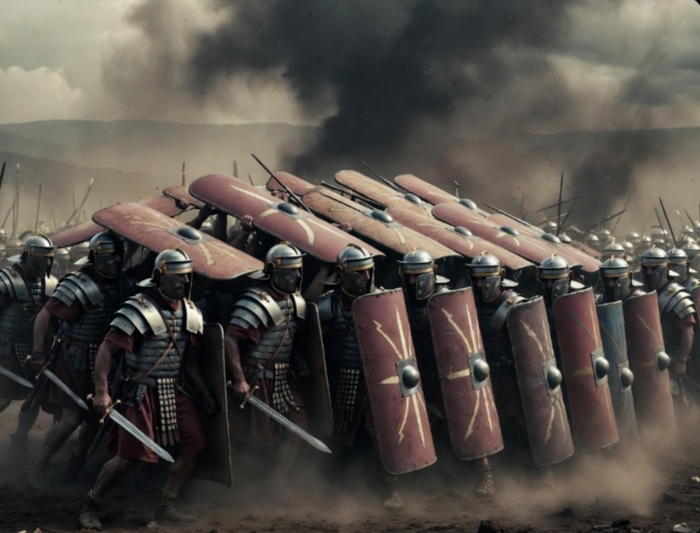
From this perspective, a church community’s corporate faithfulness protects the wounded. When the “flaming darts” of accusation and despair hit my life and my private shield wavers, your shared trust catches the blow for me.
The Surgical Blade
Notice, only at the very end of the list does Paul introduce a weapon that’s both defensive and offensive. “The sword of the Spirit, which is the word of God.” (Ephesians 6:17). However, the type of sword Paul specifies changes everything. He doesn’t use the word rhomphaia – which is a massive, heavy, two-handed broadsword (as pictured above). That sword was used to hack down lines of enemies on a charging battlefield. Instead, Paul chooses the word machaira.
The machaira was a short sword or dagger. It’s a close-quarters weapon used in a very tight military formation when the enemy presses in so close they’re practically breathing on top of you (Eww! dog breath!).

That’s not the sort of weapon a lonely hero uses to chase down foes in the distance. It’s a weapon to defend the person standing right next to you. Furthermore, a short blade like the machaira isn’t for wild, swinging devastation. It’s a tool of surgical slicing.
When the Accuser whispers localized lies, bitterness, and paranoid scripts into the ears of a Christian community (“They don’t respect you,” “You should hold a grudge,” “You’re a failure”), the church doesn’t swing a broad theological club to smash people. Instead, we use the spoken word of God (the rhema of God) to precisely slice those specific lies away. We use Scripture to cut through the localized anxiety and false frames of reference before they can infect the camp. It’s offensive, but it’s the offense of truth-telling that heals, carving out space for a reconciled, healthy Christian community to grow.
The Friction of Presence
This brings us back down to the ground floor of our actual lives. Remaining relationally faithful in a local church community is an emotionally (sometimes physically also) exhausting, high-friction endeavor. It rubs raw against our modern desire for autonomy, convenience, and comfort. It requires us to show up, stay put, and do the slow, un-glamorous work of mutual submission.
Our modern, hyper-vigilant interpretive lens would rather treat spiritual warfare as an abstract, cosmic battle. That feels much more exciting. It’s significantly less demanding, to try to map out territorial spirits in the cosmic attic than to forgive the person who offended us in the church fellowship hall. We’d rather shout at an invisible enemy in our private prayer space than sit across a table and do the agonizing work of reconciling a broken relationship.
But the New Testament refuses to give us that out.
I put it to you; the powers of darkness are disarmed and defeated when a group of messy, ordinary people refuse to stop loving each other. The ultimate act of spiritual defiance isn’t a spectacular deliverance service. Instead, it’s a local church community clothed in truth, righteousness, peace, and mutual faithfulness, surgically slicing through gossip and accusation, and stubbornly refusing to break formation.
The world around us fractures into an abyss of polarization and anxiety. However, our calling is simply to get dressed, lock shields, and keep standing. And when we’ve done everything to keep standing; stand some more.