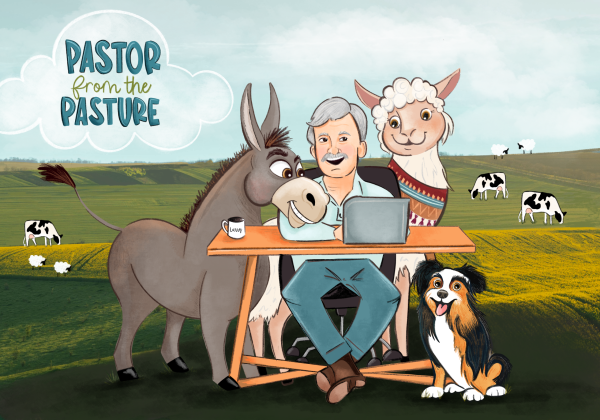
This is a follow up article related to Letters From the Pasture: Why I Write From Isolation

The digital world is puzzling. On one hand it gives us instant connection and unprecedented means to communicate, yet it often feels like a lonely, high-stakes battleground. It’s often a contest of certainty where empathy evapourates. There must be a better way to community than what conventional institutions or mainstream media offer. But to get there, we need to name the invisible wall that keeps us isolated: The Comment Culture.
The Toxic Trifecta of Digital Dialogue
I don’t believe thoughtful people avoid engaging online because they’re lazy and can’t be bothered; it’s self-preservation. We all know painfully well what it’s like to be on the receiving end of critical and caustic comments. In trying to understand the comment culture, I discovered that our current social platforms are built to incentivize a specific kind of interaction, creating a “Toxic Trifecta” that punishes thoughtful reflection:
1. The Reactivity Trap
Social media is designed for speed. You probably see that on Facebook and I see it daily on X (Twitter). I’ve asked Grok; Elon Musk’s AI tool, about my experiences on X and it acknowledges that the platform isn’t designed for reflective discussion. Algorithms reward the first, loudest, and most extreme responses. When a thoughtful, nuanced comment takes five minutes to type, it’s often drowned out by at least three immediate, one-sentence reactions that are fueled by adrenaline, not reflection. This turns dialogue into a race to the bottom, prioritizing reaction over reflection.
2. The Spectator Effect
In a large, public comment section (like on X, or an open Facebook group), our comments aren’t just for the author; they’re for everyone. This transforms a potential conversation between two people into a performance for a potentially hostile crowd. When we know every word is being scrutinized for a flaw or a misstep that could invite attack, the natural response is silence. This is particularly true for those of us navigating faith, where one honest question can trigger a public chewing out!
3. The Lack of Trust and Context
On major platforms, we comment under our real name (or an alias), but we lack the shared context and trust of a real-life community. A simple, searching question like, “I’m not sure if I believe in that anymore,” can be an invitation to dialogue within a high-trust community, but it can also paint a target on your back for judgment from an anonymous, drive-by critic.
Presenting a Profound Challenge
For people of faith, the toxic trifecta presents a profound challenge. Jesus calls us to slow truth, not quick takes – quick to listen, slow to speak and slow to outrage (James 1:19) but the digital world rewards the opposite. A pattern that Paul urges us to replace in our Faithful Faith Formation in a Formative World series. This is something we figure out through prayerful reflection, not reaction triggered from impulse. Yet how easily are we swept up in the same noisy current, mistaking volume for conviction and visibility for fruitfulness.
This is an age of outrage over words. “Word are violence” many declare. Not so for words alone, but we all know the deep pain of misused words. “Sticks and stones may break my bones but words will never hurt me.” Lie! Words hurled by the restless evil of an untamed tongue full of deadly poison can indeed destroy – even a digital tongue! (James 3:8)
The Apostle James warned of the tongue’s power to bless and to curse — a fire capable of setting a forest ablaze (James 3:5–6). He couldn’t have imagined Twitter, TikTok or Facebook, but his words ring truer than ever. What we post reveals more than our opinions; it reveals our formation.
Why We Don’t Feel Safe Speaking
Like I shared elsewhere, since retiring from a hybrid career of pastor/school custodian, my social circle collapsed. I purpose to create a safe digital community with the goal toward gathering a local in-person community, including dechurched and spiritually uncertain persons; the challenge is making myself known. But I get it…
Many people, tired of the noise, have retreated from comment sections altogether.
It’s not that they have nothing to say — it’s that the public square has lost its safety. In many spaces, (like what does it say when a social platform calls itself “Discord?”) to speak vulnerably is to invite attack or correction, not compassion. To ask a question is to risk being labeled.
This loss of trust in conversation mirrors a broader spiritual illness: the collapse of covenantal dialogue. Fewer see conversation as an exchange between persons who bear the image of God, but rather as a battlefield of competing certainties. However, the digital world isn’t the cause of this spiritual illness.
The Father of Cyberpsychology
I think it’s easy for us to blame technology for the breakdown in behaviour online. But there are deeper roots that run through the human heart. Jesus puts it this way in Mark 7:21-23, “What comes out of a person is what defiles them. For it is from within, out of a person’s heart…”
Over 20 years ago, psychologist and world renowned Father of Cyberpsychology, John Suler identified how distance and anonymity create what he calls, online disinhibition effect. This effect displays a digital loosening of restraint that lets anger and contempt to surface unchecked. More recently, observers like Jean Twenge and Jonathan Haidt point out that social media didn’t create our crisis of empathy and trust; it merely magnified what was already there. What shows up on our screens isn’t a new spiritual sickness that I dreamt up. It’s an old one, a well worn pattern of the world that forms us. The internet just gives it a louder voice.
Yet if the digital world exposes how far we’ve drifted from seeing one another as carrying God’s image, it may also invite us back toward relearning the art of covenantal conversation.
Relearning the Art of Covenantal Conversation
Covenantal conversation begins where contractual debate ends. It seeks to understand before being understood – agreement (even agreeing to disagree) and relationship before resolution. It doesn’t demand that every question be settled – it honours the mystery in the middle (even when I want answers, certainty and solutions).
In this world, words are used as weapons but in God’s world, words are seeds – planted in the soil of mutual respect, watered by patience, and tended by love. This is my vision for writing…
I don’t write because I have an audience. I write because there’s seed to scatter – ancient seed that still carries life. This older worship song by Robin Mark speaks deeply to me of the power within these ancient seeds.
Covenant conversation doesn’t start with a crowd; it begins with a few farmer types who know the scent of turned soil and the patience it takes for unseen things to grow. My dream for a covenant community isn’t about gathering a crowd – it’s about replanting what was once alive and trusting that others, somewhere, might join me in the field.
Writing From the Pasture
That’s why I write from the pasture (the inspiration for my comic graphic)
In an online world that rewards outrage and immediacy, the pasture is a slow, gentle place.
There’s no algorithm, like there is on Facebook (and other socials), that shapes your mind toward continuous scrolling, no trending topic to chase — just silence, space, and the kind work of words formed through prayer and puzzling over.
I write…not to provoke reaction but to cultivate reflection.
Not to compete with certainty, but to explore the Christian faith’s holy questions.
Not to argue for attention, but to be a companion for others who, like me, are trying to rediscover what covenantal community might look like in a fragmented Canadian society.
Maybe that’s naïve. Maybe it’s old-fashioned (I am a bit of an old guy afterall). But perhaps what our moment needs most is not another platformed argument, but a few quiet voices willing to stand in the tension — to speak truth with tenderness, to critique without contempt, and to imagine with integrity.
From Comment Box to the Covenant Table
It seems to me what the Church needs now isn’t louder voices but deeper ones.
Spaces not for reaction but for reflection.
Conversations not built on winning but on wondering.
If the comment box has become a battleground, maybe it’s time to move the conversation back to the table – the covenant table where Christ gathered His friends and where He still gathers the uncertain, the overlooked, and the misunderstood.
It’s there, where words are shared slowly.
Questions honoured.
Grace has the final say.
Until then, I’ll keep writing from the pasture – trusting that ancient words, faithful words, offered humbly, might yet re-enchant a disenchanted world. Maybe the future of Christian conversation won’t be on viral threads but quiet tables – digital or otherwise, where words again, become good seed.