
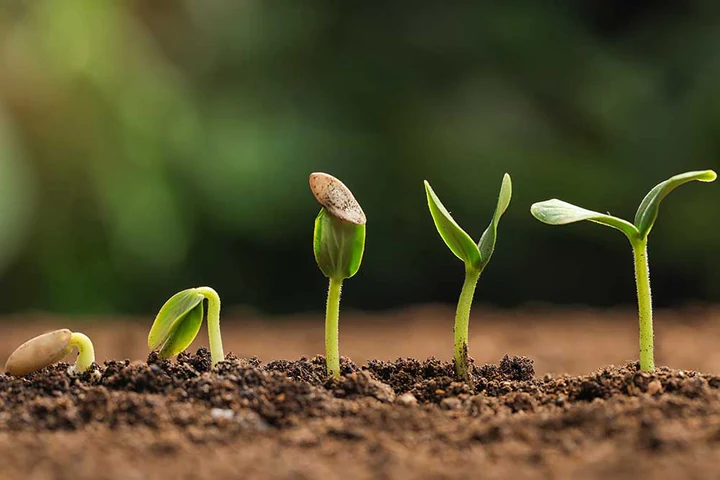
Last time, we discovered how the early church is seen as a seed, not a blueprint. Now, to see what was alive among them, the place to start paying attention to: what kind of life grows when the seed is planted.
- Not the structure.
- Not the form it took.
- Not the patterns we can trace.
But what seemed to consistently appear wherever that life took root.
What kind of life grows when the seed is planted? Ultimately, a seed expresses itself differently depending on the soil, but it doesn’t become something else entirely. There’s a continuity to it – desirable qualities to the life that shows up even though it may look different from one place to another. That’s what we’re listening for today.
- Not instructions.
- Not models.
But the sound of something alive.
An Ancient Lived Experience
If you stepped into one of those early communities, I suspect things would look kind of plain; not very impressive. First, there weren’t buildings set apart for what they were doing – no campus sites, no satellite locations. No visible synagogue structure that signaled something significant was happening there. Instead, their gatherings were woven into the ordinary spaces of life – homes, tables, and shared routines.
But stay a bit longer, and something starts to surface. Not in what they were organizing, but in how they lived. There was a nearness to God that didn’t feel staged. Not something they tried to achieve or produce, but something they seemed to live within. They spoke to God and about God with a familiarity that didn’t draw attention to themselves. The people just assumed God was present – not occasionally, but always.
God’s Nearness – Then and Now
God’s nearness didn’t come from their ability to invite or somehow draw God in from His space into theirs. It rested on something more settled than that. They understood themselves to be in a living relationship God had already established – a covenant not dependent upon their consistency, but on His. The Spirit’s presence wasn’t something to secure, but something to live within.
Because, when presence is assumed rather than pursued as an outcome, life starts to settle differently. There’s less effort to try to “get somewhere” and more learning to remain and be faithful where you already are.
As it was then, so it is now. That’s our kind of “settled water” from Psalm 23. A settledness that comes from slowing down.
When Life Gets Divided
You’d also notice they didn’t divide their life the way we often divide ours. There wasn’t a clear line between what was “spiritual” and what wasn’t. Meals, conversations, work, prayer – these weren’t separate compartments. They were part of a shared life that held together.
Additionally, faith wasn’t something they attended to. It was something they participated in. And participation changes the feel of everything. People weren’t primarily spectators. They were involved – known to one another, needed by one another. And I don’t mean needed in an organized or optimized systems way as most of our lives are like today. No, I mean in the organic or natural way that happens when lives are actually shared.
That kind of relational dynamic doesn’t come from structure alone – it’s not something we can schedule and scale. Instead, it grows when people remain long enough for their lives to overlap – when presence isn’t rushed, and relationships aren’t managed at a distance.
K.I.S.S
Keep it Simple Sticky. There was also a simplicity to their life together.
- Not as a mission and vision statement.
- Not as a rejection of the world around them.
But as a result of what mattered to them.
When life centers around presence (God’s and one another’s) and shared participation, excess has a way of losing its pull. Not because we reject it, but because we don’t need it to carry the weight we often give to structure and stuff.
Not All Butterflies and Buttercups
I’m not saying their lives were easy. Far from it! They lived with pressure – social, political, economic, relational. Many of them navigated uncertainty and limitation in ways that feel familiar to us. But that pressure didn’t seem to fracture their life together. If anything, it revealed something else that was present. A kind of resilience.
I’m not talking about the resilience that comes from a rugged, pull up your bootstraps and push harder or manage better, but the resilience that comes from not carrying life alone. Rather than concern about being a burden, they shared one another’s burdens. When life was hard they didn’t run away; they remained for each other.
You can’t organize that kind of settledness and resilience into existence. Inevitable friction can’t be fixed because people aren’t problems to solve. Settledness and resilience grows where people are willing to stay and flex with friction.
Time
Underneath it all, they had a different relationship to time. Things didn’t move quickly. There wasn’t a sense of needing to accelerate outcomes or scale up what was happening. Growth wasn’t measured in expansion, but in depth – the gradual shaping of a people learning to live in God’s presence together.
I think it’s easy to miss this when we read their story from pages of a distant past. We see movement, spread and momentum that seems to happen at speed. But within their actual lives, much of what mattered most would have felt slow, ordinary, even unnoticed. Like most living things do while they’re growing.
What’s the Plan?
There wasn’t one! None of this forms a blueprint. You can’t take these observations and create a system that guarantees the same result. You can gather in homes, share meals, simplify your life, and still miss the very thing that made those Christian communities what they were.
Because, we’re not exploring what they did but rather, how they lived. A life that, wherever it was present, seemed to carry certain qualities with it:
- a nearness of God to live, not perform
- a shared participation rather than passive belonging
- a simplicity shaped by what mattered
- a resilience formed in staying together under pressure
- a pace that allowed life to take root rather than rush past it
These weren’t requirements; they seemed to grow naturally from what was alive among them.
From Seed to Plant
If the early church is a seed, then this is what we’re noticing. Not the plant in its final form, but the life it consistently produces. And that leaves us with a different kind of question to consider next time.
Not: How do we become like them?
But: If this kind of life is present among us…in what environment does this Christian community exist?