
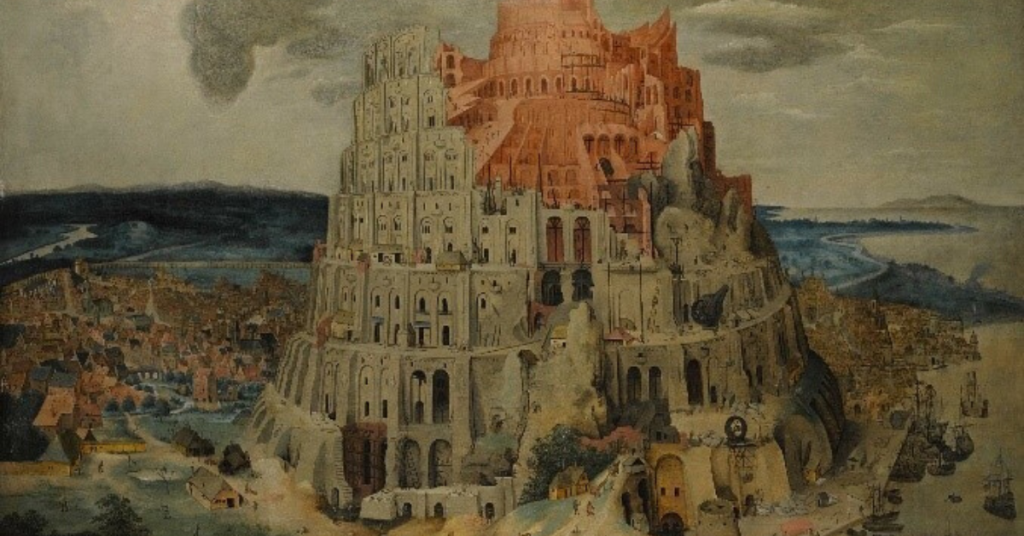
When Want Outgrows Wisdom (Genesis 6-11)
Previously we explored how rightly directed desire distorts and becomes a personal problem. But now the Genesis story goes global. Moving beyond a distortion of desire and interpersonal, fractured, relationships between God, Adam & Eve and Cain. Human longing starts spreading as a collective distorted desire into households and eventually into the structures and aspirations of entire communities. it’s desire gone wild.
Initially, desire was designed to align with God’s goodness and creation’s well-being but now it fuels imagination in a different direction; it leans into power, control and self-made security. Now, we explore a new, sobering development. Human desire goes postal and eventually becomes weaponized. The outcome isn’t only moral decline, but culture develops at a rate to where it outpaces wisdom itself. This is where the story now turns.
Framing the Narrative: When the Community’s Desire Turns Dreadful
Genesis 6-11 marks a tearful turn in the biblical story. Turning toward self, the desire of Genesis 3-4 doesn’t stay a personal problem. It slowly swells – silently and surely into a collective disorder. If Genesis 1-2 offers a world where human desire was meant to harmonize with God’s hospitality, and Genesis 3-4 shows how desire can fracture the individual and our most intimate relationships, furthermore, Genesis 6-11 shows what happens when misdirected desire becomes the organizing principle of an entire society.
Now overlay the Genesis story with ancient Near East societies – talk about culture clash! Mesopotamian myths had people believing that human ambition, technological progress, and massive building projects were signs of the gods’ favour or even imitating the gods. Where ancient stories celebrated kings and cities as the peak of human achievement, Genesis frames them as cautionary tales.
Don’t hear what Genesis isn’t saying. The issue isn’t human ability but human desire directed away from wisdom, community, and human limits. When misdirected desire starts as self-preservation, it ends in self-glorification. What begins as innovation becomes domination. What begins as unity becomes uniformity.
The stories from the Flood through Babel aren’t random moral tales. They’re stories about the study of God (theology), the study of what makes us human (anthropology) and the study of how social matters influence human behavior (sociology). They offer a profound diagnosis of the human condition. When human want extends beyond human wisdom, it becomes a huge problem.
The Exegetical Core: A Portrait of Disordered Collective Desire
The Flood Narrative (Genesis 6–9): Desire Without Restraint
Genesis 6 opens with a world in which desire runs wild. “Yahweh saw that humanity’s bad state on the earth was great. The entire inclination of its mind’s intentions was simply bad, all day” (verse 5, The First Testament by John Goldingay – A New Translation).
In Hebrew thought, this isn’t a psychological diagnosis but a relational one. The whole human posture was bent away from God, away from neighbor, away from creation’s good order.
The violence that fills the earth isn’t random but the result of desire unhitched from a loyal bond. Humans grasp, grab, dominate, and consume with no regard for the relational fabric that makes life possible. In a radical reversal of Genesis 1, we could say the world became “uncreated” – a return to watery chaos; “darkness over the face of the deep.” But the purpose isn’t destruction for the sake of destruction. God preserves a remnant because His desire remains firm. God longs to bring creation toward its flourishing.
The Table of Nations (Genesis 10): Desire in Expansion
At first, Genesis 10 reads like an ancient census but it serves a greater purpose. It tells how human beings expand, migrate, diversify, and establish societies. At this point, there’s nothing concerning happening. Nations spread out according to their clans, languages, lands, and nations and the diversity of peoples is a sign of blessing, not a curse.
However, notice the signal of distorted desire starting to play out with Nimrod. He’s not only a hunter; he becomes the gold standard of empire-building. His cities of Babel, Nineveh, and others represent what we see as centralized power, colossal culture, and the first formation of systems in which desire becomes nationalized. No longer is desire an individual inspiration; it turns toward institutional ambition.
The Tower of Babel (Genesis 11): Desire Consolidated and Weaponized
Genesis 6 shows desire unrestrained but Genesis 10 shows desire expanded – then, Genesis 11 shows desire enthroned. The Babel narrative is a short account with profoundly deep content. We see humanity gathering around three motivations:
- 1. “Let us build ourselves a city” – creating security through human achievement.
- 2. “Let us make a name for ourselves” – identity apart from God’s calling.
- 3. “Otherwise we’ll be scattered across the planet” – fear of vulnerability or dependence.
Each statement reveals a community attempting to insulate itself from mortality. They want a world in which need, limits, and diversity are threats rather than gifts. Instead of displaying God’s image, they attempt to highlight their own. Instead of participating in God’s mission, they create a competing one – architectural, technological, and ideological.
The tower isn’t a stairway to heaven; it’s a monument that places human self-preservation and self-exaltation on the throne. It’s the culmination of distorted desire; the attempt to transcend the created order of things.
God’s response? Meh, not impressed. He mixes up the language and scatters people groups – it’s not punishment but protection. Dissemination prevents domination. Diversity becomes a safeguard against consolidating and totalizing desire.
Genesis 11 isn’t the story of a small, petty God feeling threatened and thwarting human creativity. Instead it’s the story of a wise God preventing humanity from destroying itself.
A Quiet Word for Our Canadian Moment
As I reflect upon this ancient critique, I can’t help but feel how contemporary it is. The desires; the motivations of Babel – security, identity-building, resistance to vulnerability, echo through every age, even ours. We build towers too. They’re not made of brick and mortar, but of technology, data, policy, capital, and ideology. We call them institutions, political parties, corporations, NGOs, and systems. They’re different shapes and sizes. The engines that drive them differ. But their logic is often the same – human desire unchained from humility.
The Canada most of us have trusted in is vanishing. As you spend time on social platforms, taking in the news, or listening to podcasts, our current cultural landscape is in view. We’re socially fragmented, politically polarized, and economically anxious. The desire to consolidate power, enforce uniformity, or construct narratives of cultural self-preservation is strong. Communities lean toward ideological fortresses, each convinced it must “make a name for itself” or risk being irrelevant. We see the results: suspicion, rivalry, tribalism, and a fragile public square.
In his book, The Prophetic Imagination Walter Brueggemann speaks often of the “royal consciousness” – the mindset that equates security with control, unity with conformity, and identity with dominance. Babel is the royal consciousness in its earliest form. It’s what happens when the desire of a community becomes an echo chamber rather than a shared vocation.
But Genesis 6-11 offers more than diagnosis. It offers an alternative imagination. God doesn’t abandon the scattered peoples, but accompanies them. This diversity becomes the stage on which God’s covenant grace later unfolds. For we will see scattered nations become the recipients of a blessing that begins with Abram in the very next chapter.
For those of us who desire to live faithfully in a fractured culture, God’s invitation is compassionate but clear. Move away from the towers, away from the illusion of control, and back toward the slow, relational work of commitment-oriented life. Resist desires to possess or control – political, personal, or church; things that promise security at the cost of humanity. Instead, turn your desire toward the kind of community that’s pointed in the right direction: actively engaged toward God, neighbour, as well as extending mercy and grace for the well-being of all creation.